Bassdee
Interview
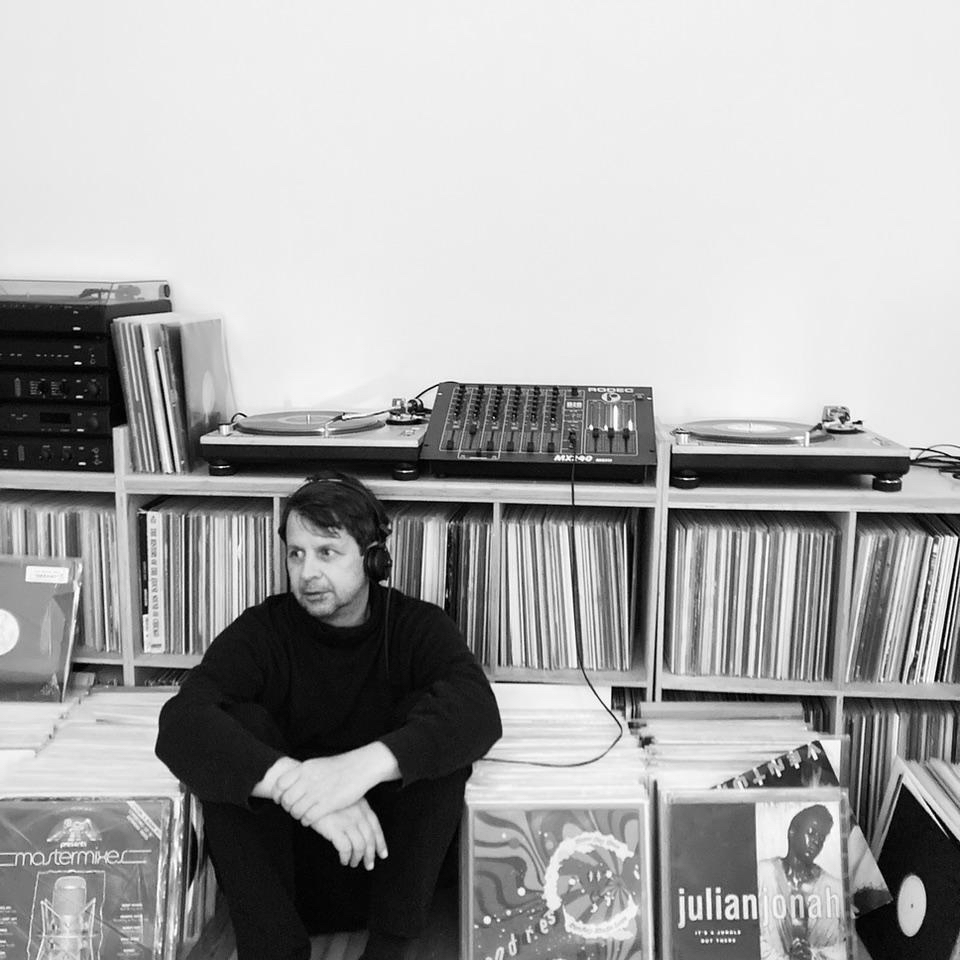
Q: Hello BassDee! As expected, huge stacks of vinyl pile up in your flat – but the grand piano with the Debussy sheet music on top almost dominates even more. How did music enter your life?
My father is from the Lausitz region and studied music in the former GDR until shortly after the uprising in 1953. My grandfather, on the other hand, was a pastor, and because of the political developments over time the family faced more and more problems. Back then there was also the accusation that the church had been infiltrated by the American secret service. On top of that, my father was afraid of ending up as an oboe-playing musician in the orchestra pit of some small provincial theatre. And when they realized that everything in the GDR was only getting worse, he fled to West Berlin about a year after June 17. Once here, he began studying medicine. My mother, meanwhile, always played string instruments, and the two of them funnily enough met in a classical orchestra. So we four children all had the opportunity to learn musical instruments. I myself started playing piano at the age of six. And sometime toward the end of the ’70s we had an au pair girl. She had a cassette with her that she gave to me, full of disco music. Blondie’s “Rapture” was on it too – I still remember that today.
Q: How did things develop after that discovery?
This disco cassette, but also my older siblings, had a huge influence on me. We quickly started listening to the radio very deliberately. For example, SFB had a great show called The Big Beat with Monika Dietl. In late 1988 my older brother had a friend with a DUAL turntable. We modified it so we could change the pitch. And that’s how we started mixing. At a BCM label showcase at the Tempodrom, with De La Soul among others, we saw a hip-hop DJ scratch live for the first time. That really opened our eyes technically. At first we didn’t even know you needed slipmats to cue up or scratch tracks. Later I heard DJ Jonzon, who brought acid house and the whole US house sound from Chicago and Detroit to Berlin together with Motte, play at the UFO Club. I loved his purist sound aesthetic and his sense of style – that impressed me deeply.
Q: Around 1991 you were in London and brought back a big crate of records. What else made that trip to the English capital so special for you?
First and foremost the multicultural sound system culture and the way all kinds of people celebrated together. To this day in Berlin it’s still rare, for example, that people stand in a club together with the Turkish community. In London – maybe that has changed by now – that wasn’t the case; everyone really stood together. Whether house, techno, or reggae. And from 1992 on you could clearly see: something’s coming with jungle. So we tried to build something like that in Berlin. Sure, at the beginning hardly anyone came to our nights, but in 1994 Goldie’s album dropped and suddenly there were stories in SPEX, in Die Zeit, and so on. Kiss FM then looked for DJs in Berlin who knew about this new direction for a radio show, and the Monday night show “Radio Massive” was born.
Q: Did you ever think of developing a plan B alongside your emerging DJ career?
I was studying at the time, and looking back you could ask whether I should have closed one of those doors a bit earlier. For ten years I was constantly at the limit. Two fully completed degrees and three to four DJ gigs per week ... that didn’t end well. And all those who started around the same time as me, but professionalized the DJing earlier, are doing pretty well now. Later I worked nine-to-five for years and felt unhappy – that’s just not my world. These days the DJ gigs are going quite well again and I can make a decent living with it.
Q: If someone nowadays books you for a pure drum’n’bass classics night, how do you feel about such a request?
Honestly, I’m thrilled. Of course, I don’t want a museification of drum & bass. But people like me know music that’s long been forgotten. You won’t find it on YouTube or Discogs, and no algorithm will find it either. And when you bring that back for younger people – also the aesthetic that drum’n’bass carried – you can really create something. You always have to weigh old and new tracks, because drum’n’bass has it incredibly hard in Berlin today. Even though for about five years now there’s been a really great revival happening, with a very diverse sound spectrum. For example, from Fabio & Grooverider or DJ Madcap you hear remarkable sets on SoundCloud that really excite me.
Q: How did you experience someone like Goldie at that time?
Well, Goldie has a phenomenal charisma. He was simply on an unbelievable mission ... he had a vision of how this way of life should be conveyed, and since 1991 he was fully immersed. Fabio and Grooverider were one of the nuclei. I was at RAGE in London in 1991, and it felt like every 20 minutes they played Lenny De Ice’s “We Are IE.” It blew me away. Besides the tracks by Frankie Bones, that must have been the first track I consciously perceived with the Amen break at that speed, and all the DJs played it there. They threw everything into one pot and stirred it up with breakbeats – people like Colin Faver as well. And Marc and Dego from 4hero and A Guy Called Gerald added their ingredients elsewhere and served as mentors.
Q: Please comment on the 1997 Hard:Edged–Metalheadz party at Flutgraben in Treptow!
Insane. Just insane. I had three gigs to play that night. Around half past two I left the Hard:Edged party after my set before (I think) Doc Scott – a friend kindly drove me through the night to Nation of Gondwana outside the city – and I came back to the hall at around half past nine in the morning. It was our event after all. There were still well over 1,000 people on the floor and Grooverider played his set at 9 a.m. If I remember correctly, he played until noon – he probably never did that in London in his life. And as the Hard:Edged crew we learned an incredible amount from that event. The Brits had given us quite a few stern instructions regarding the equipment on site and so on. A bit shocking. Financially it was way beyond our limits, but we wanted to try it and push it through. It was the Golden Era and we wanted to show the 4-to-the-floor Love Parade community: Look, there’s something else out there.
Q: The night was also powered by a gigantic sound system.
For us, great sound with the best system available in Berlin was, next to the music, the most important thing at every event. We wanted to offer our guests the best sound possible. The Brits had brought their own sound engineer for the Metalheadz session. He did something with the system beforehand that I’ve never seen again. He simply turned all the amps and all the channels on the mixer to full blast up to the point of feedback, and then adjusted the equalizer based on the audible background noise of the Technics decks. He removed all the frequencies that bothered him with the EQ and then put on the first drum’n’bass record. It just blew us away.
Q: With the label “Case Invaders,” which you co-founded, you also focused on scouting local talent.
I have a really bad conscience about that. I received quite a lot of DATs with music and while listening I was always looking for something very specific. Recently I dug up some of those old DATs and was shocked by what we had overlooked. Many tracks were incredibly abstract and good – if we had given them a chance, maybe mixed them a bit better and let the artists develop over a couple of releases – they might have become something really special. We also kept asking: Is this competitive with the English stuff? Which, of course, was nonsense. And then you got so much music people had put their heart into, and you had 10 to 20 minutes to judge it. I don’t know how others do it, but I fear that with my lack of response I often demotivated people.
Q: What was the basic idea behind the label’s releases?
Reinforced was definitely our role model. They always released a lot, and some things sounded a bit unfinished, like on a playground. We wanted to get things moving. Everyone who released something with us made a big leap because of it. Suddenly they held their own tracks on vinyl in their hands, that did something to them, and they got even better the next time. It was never about money. Covering costs, yes, with a run of 500 copies, but everything else went to the artists. And selling 500 pieces of vinyl was already difficult back then, and soon the run sizes dropped and the vinyl crisis began.
Q: Which sets that you played yourself stand out as personal highlights?
There are many. In drum & bass probably the first three Hard:Edged parties we put on. Or the Carnival of Cultures ’95 or ’96, when we drove under the bridge at Kottbusser Tor with our float and the sound bounced back from above and suddenly it sounded like a club. We played “Fight the Power” by Public Enemy as a statement and the whole Kotti went completely wild. We actually went down to the driver and asked him: Please just stay right here for the next two hours until the police come. The whole square with a few thousand people going absolutely crazy ... magic! At WMF on Johannisstraße basically every night was incredible. And in Mannheim I also played a few times, also with Doc Scott and Grooverider – that was great too.
Q: And which DJs have really stayed with you?
Kemi & Storm. By far. In 1995 Björk played a concert at the Tempodrom, Goldie was sort of the opening act, Goldie’s Timeless had just come out and we thought: Let’s put together an aftershow party with Metalheadz DJs from London. It must have been a Thursday night at the Toaster (a former club in Berlin), and for me – and a few hundred others – our jaws dropped during their set. After that we kept bringing them over and they always, absolutely always, delivered. By the way, I think the only one of us who actually made it over to the UK was MC Jamie White. And a bit later Felix K.
Thank you for the interview, BassDee!
TheSeasideView wants you to see this: