
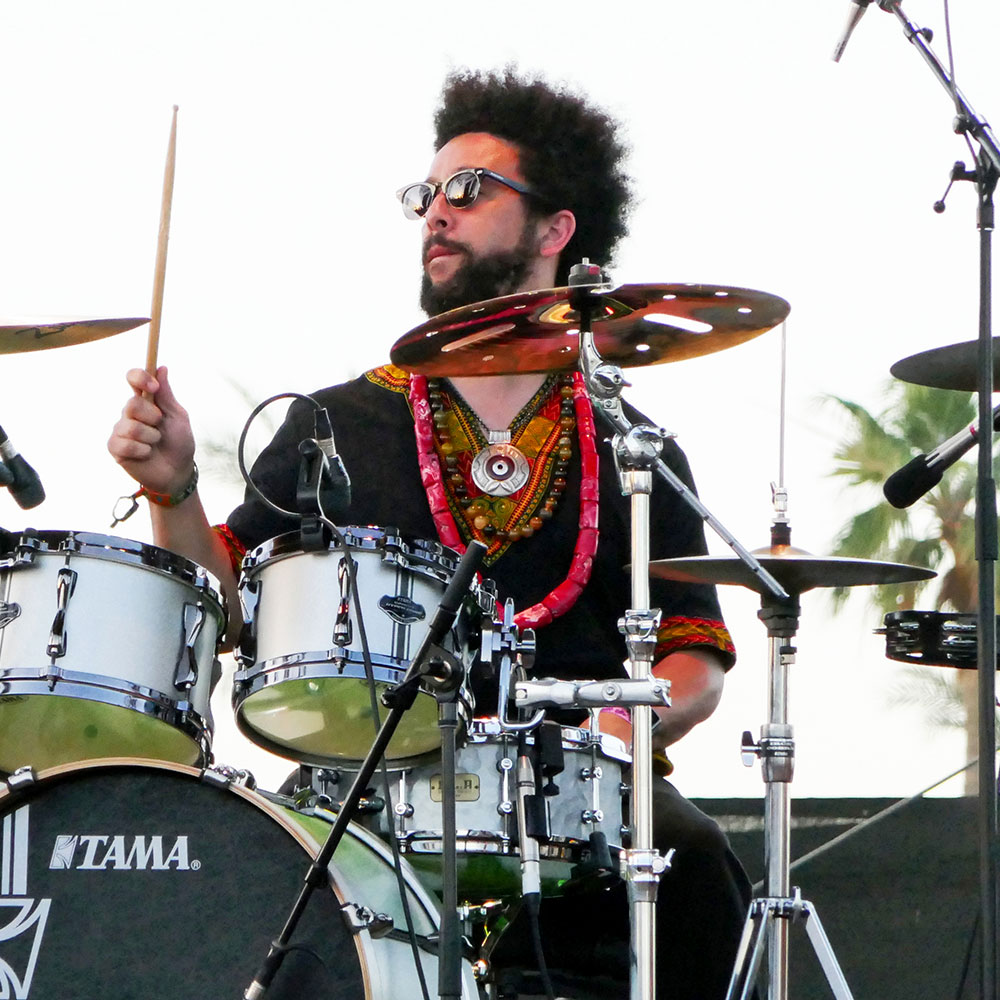
Tony Austin
Interview
Q: Hi Tony! Please give a small introduction on how music got into your life!
I was born and raised in Los Angeles and both of my parents were
musicians. My father was a drummer, and I would go to his shows in the
70s and 80s, he played popular music. So, I took sticks in my hands
probably just being three years old and also got a toy drum kit at some
point. But then my parents split up when I was seven and my dad wasn’t
really around anymore for a real long time. So, my mom facilitated me to
get formal lessons and was getting me into music programs. Doing local
gigs at jazz clubs and restaurants I started to play more and more
professionally over the years. At some point I met up with Ricky
Washington - Kamasi’s father - we did a gig together. He told me about
his son that he wanted me to jam with, and I remember that so well
because Kamasi is such a unique name. Kamasi was about 14 or 15 at
that time but my ear could already tell where he was going and that at
some point, he was going to be badass.
Q: Did you grow up in the same neighborhood?
No, not at all. LA is a huge city - you can drive for two hours in one
direction and not have left town. The music community is fairly small
though. But when we were kids there were many privately funded
programs where we would run into each other, and we met at jam
sessions. There were two jazz clubs: one was owned by a guy called
Richard who lived on skid row but got a loan one day and opened a club
called “District Six”. Around the corner was another place called the “The
World Stage”. The owner, Billy Higgins, who was a drummer and later
became a good friend, would hang around there all the time. So, a lot of
us kids and young adults spent hours there, too.
Q: How many hours did you practice at that time per day?
Probably six to seven hours. When I was young and you wanted to take it
further you basically had two choices: jazz or classical percussion. I found
playing jazz more exciting, so I went for that. I was also playing the
vibraphone and marimba and did marching in a drumline for a long time.
So, I tried to take these fundamentals to the drum kit and at the same
time listened to a lot of different stuff. My mom also listened to a lot of
jazz and contemporary music at home. Not stuff that was popular with
other kids or stuff that was on the radio. Anyway, I guess I did not really
find my independent voice in jazz until I was in high school when I got to
listen to a Miles Davis record on which Tony Williams was playing. That’s
when I was kind of like “Oh! Now this is different!” and I headed more into
that direction.
Q: Why did Tony Williams become such a strong influence and guide for your playing? Have you ever met him?
Tony was just unique and the stuff he did especially in the 60s just caught
my ear. I mean I listened to all kinds of drummers, but he was more
expressive in my opinion and was always trying to have a conversation
with his band members. It got me excited how they interacted with each
other. And at some point, Billy Higgins, the owner of the club we talked
about before, told me “Man, Tony Williams is coming to town, let me
introduce you to him!”. But then Tony passed away just two days before.
Q: When and where did you meet up with Miles Mosley?
He and I met when he was around 15 and at some point, around 2009,
we got a residence at a place called “The Piano Bar” in Hollywood. No
one was really listening to what we were playing there. It was pure
background music. So instead of suffering the ignorance from the
audience we said,
“Fuck it, let’s try to experiment and do stuff we
normally would not do at a gig because no one is listening anyway. Who
cares if we make mistakes?” The club owner wasn’t really strict about
what we played so we took that place to make our music evolve and
stretch out into new territory. A lot of Kamasi’s music today and our
communication on stage thrives from that time.
Q: Do you sometimes discover new artists today via social media or YouTube that make you think “Wow! This is great!”?
Well, there is all kinds of stuff out there that is appealing, the thing is: I am
a musician. I study music constantly. Musical discoveries… it is tough
because I analyze pieces of music all the time. It can happen for
compositional reasons or producing reasons that I like someone and then
I go and check out the people behind it. It is less of an exciting feeling
though - it is more about learning and finding out about new techniques.
So, it feels more like a part of work for me, but it is work I do with a lot of
passion. And I listen to stuff every single day.
Q: How did you step into the recording side of music?
After my parents had broken up my mom decided to enroll me in this “Big
Brother” program. Which is where they pair a single child with an older
“Brother”, who is like a mentor to that child. You are supposed to meet
with them once per week and they take you out to the park or to
Disneyland or to whatever. When I was getting involved, they wanted to
see what kind of interests you have and then pair you with someone who
has equal interests. My match was a guy called Roger Linn who had
invented the first programmable drum machine, the LM-1. We met him
when he had started working for AKAI and I went to his house once a
week and played with his studio. That’s when I learned how to program
drum machines or how to work with a midi sequencer or how to record
multiple tracks on tape. Having access to technology that was state of the
art then was just so much fun. Later Roger got me a midi controller and a
real shitty IBM computer with Cakewalk so suddenly I started to make my
own tracks and got surprised when people even liked them. At some point
I would then start to record bands at high school where there was a studio
that no one really knew how to use. I recorded bands even at home on
ADAT with a small Mackie mixer. Then later came compressors, reverbs
and I kept expanding and growing this talent.
Q: So as a drummer and studio engineer: how do you protect your ears from hearing loss?
Surprisingly I don’t have as much hearing loss as I should even though I
definitely have played loud. I mean I am not in a rock band like, let’s say
Metallica, where we would play two hours straight in a brutal volume.
Plus, I don’t use headphones or turn on the music loud at home. Mixing
and engineering isn’t about hearing everything. It is more about hearing
things very accurately. It is about being focused on certain things and to
me it feels a bit like reading: reading a book also isn’t about reading the
words, it is about understanding what the words are saying. Same with
music: what is it trying to tell me?
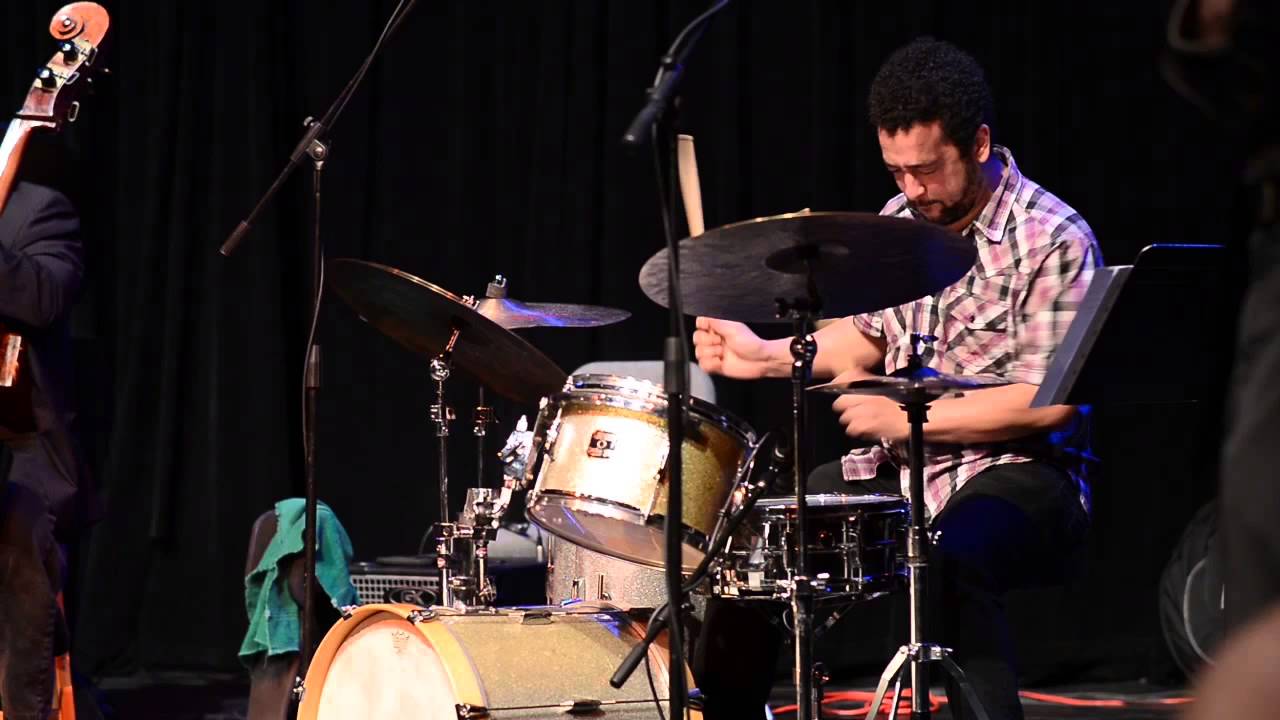
Q: Comparing Kamasi’s “Heaven and Earth” and the latest “Fearless Movement” releases sonically: any preferences? “Fearless movement” has a fantastic bass response and seems to have a different “glue” on the stereo image while “Heaven and Earth” just sounds so airy and live.
We recorded at two different studios. “Fearless Movement” was recorded
at Sunset Sound studios on a Neve console. We spent more time on that
record in general, also because of Covid. Both records were recorded
digitally on ProTools but then mixed on an SSL with analogue hardware -
real EQs, real compressors, real analogue processing. It takes longer but
it sounds better, and this is what changed the sound vastly from the “The
Epic” to “Heaven and Earth” and our latest output. On “Fearless
Movement” we also didn’t have a choir or orchestral arrangements which
gives more room. And we always - on every record - record our core band
live so whatever I play, or Brandon plays or Miles or Kamasi play shapes
the music in real time. We are creating the vibe in the studio, and we
improvise on our instruments. Then later Kamasi does his overdubs,
Patrice does her vocals and so on.
Q: Most of the members of the WestCoastGetDown Collective - that you are part of - have released solo albums. When is yours coming out?
To be honest: making a record is not only about the passion, it is also
about doing the business. Making a record costs a lot of money. You
invest time and effort, and I intend to get part of that investment back, so
the challenge is also what kind of record are the people going to buy?
And how do I sell it? It’s an ongoing study and hopefully it will come to
fruition in a release soon!
Q: Let’s talk about your stage performance. You are playing a drum solo every night. Do you plan them a little bit ahead? Are there certain chops you want to show to the audience?
I try not to load pre ideas or to plan a solo ahead. Our music is about
improvisation so if you are mediating “I want to play this” or “I want to do
that tonight” you are squeezing out any moments that can happen
naturally and that can be better than anything you had in mind before you
step on stage. I try not to be outside of the music or have any
expectations until I am inside of the music. My aim is to be inspired by
what we do on stage naturally. For that reason, I do not like to hear what
we played at a concert the night before or a week ago. We strive to create
something new every night. Our concept has always been to discover
new things as a band and to come up with things on the spot that are
unexpected.
Q: The words “stage fright” must be unknown to you.
After 40 years of playing I don’t get really nervous. The last time I got
some kind of stage fright was when I was doing a competition at 17.
I really wanted to win that one and I did. But as a fact it is more of the
opposite with me: normally before I get on stage, I get really tired. In a
way that I could nearly fall asleep. There isn’t any anxiety, and it may look
to the outside even as boredom. I guess it’s my way of preparing
energetically for what I am going to put out then.
Q: You are constantly on the road. How do you feel today when they call you up on the phone and tell you “The next world tour has just been booked”?
I do this for a living so if I don’t tour, I don’t have any money and cannot
pay my bills. I have a wife and a young daughter that I have to financially
support, be responsible for. So, it is a mixture of things. On one side I
finally have a gig, great, there is some money coming in. I don’t think
about the gloominess until I finally have to go. Traveling is very tiring
though.
Q: Traveling around the world so much, do you sometimes experience culture shock?
Not so much as I started traveling at a young age. On my first trip out of
the country, to the Montreux Jazz Festival with my high school combo, I
must have been 13 or 14. On the way back, and I cannot imagine kids
doing that today, we had a stop-over in Paris for a night and we went out
to smoke cigarettes, to buy weed and to drink beer. Kid stuff, you know.
The next trip was maybe a year later for two weeks to Japan and that yes,
was culturally shocking. Now, at my age, I’ve been to every single
continent except the Antarctic. I have been in every major city in the world
so when people sometimes come and ask me “Where have you been?” I
like to say,
“I would have an easier time telling you where I have NOT
been!”. And it is fun in a way because I have learned a lot about cultures
and languages. Now, once you get used to be exposed to different time
zones, to different climates, religions and cultures… you start to realize
how alike humans are despite those things. People have more things in
common than they think.
Q: Do you feel that the world is a bit, let’s say, on fire at the moment?
I think what is happening right now is that humans have too much access
to information. Shitty things also happened in the past, but you didn’t hear
about it every minute, every day, all the time. You pick up your cell phone
today and scroll through Instagram and see all the horrible shit going on
everywhere on this planet. Seeing how other people see the country that I
am coming from and vice versa makes me really understand that you
intensively have to do some research to not fall into this trap of seeing the
news and believing that that is the true picture. Because it is not. As a kid
during the Cold War, we as kids were told by our teachers and the media
how to think about certain things. And now I go to visit these places, and I
talk to the actual people there and I can tell: it was all bullshit what they
told us. Even in my city, in LA, it is the same: we had some pretty bad
fires recently, but they were, taking in account how big LA is, only in two
small districts. But you go out of LA and turn on the news and it sounds
as though the whole of LA is on fire! California has had fires all my life,
man! Anyway… I think it is very valuable to not react with fear or
anxiousness to what we are presented with, no matter where you get your
information from. All these media devices unfortunately are preventing
what the majority of the people globally want: to get along. To
communicate. To not overreact. We need to figure out ways to unplug,
otherwise as humans we are not going to survive.
Q: You have recently stepped into fatherhood. Has that changed you emotionally?
Absolutely. Becoming a father is probably the most unique experience I
have had in my life. And I was definitely not prepared for how I would feel
or how I would connect to my child. It is a new chapter in my life that I did
not see coming although I always wanted to have kids. But now it is here,
this new thing! This young person that is growing every day and having all
these milestones all the time. It is also rough as fuck but on the other
hand so beautiful and amazing. There are times where you think “How
am I gonna survive tomorrow?” and then there are days where you are
like “I hope this shit will never end!”. It is everything. Such a wild
experience. Hard to explain but mind-blowing. And looking into the future:
I get to relive my childhood as an adult. It is a new passion!
Q. Thanks a lot for your time, Tony!
TheSeasideView wants you to see this: